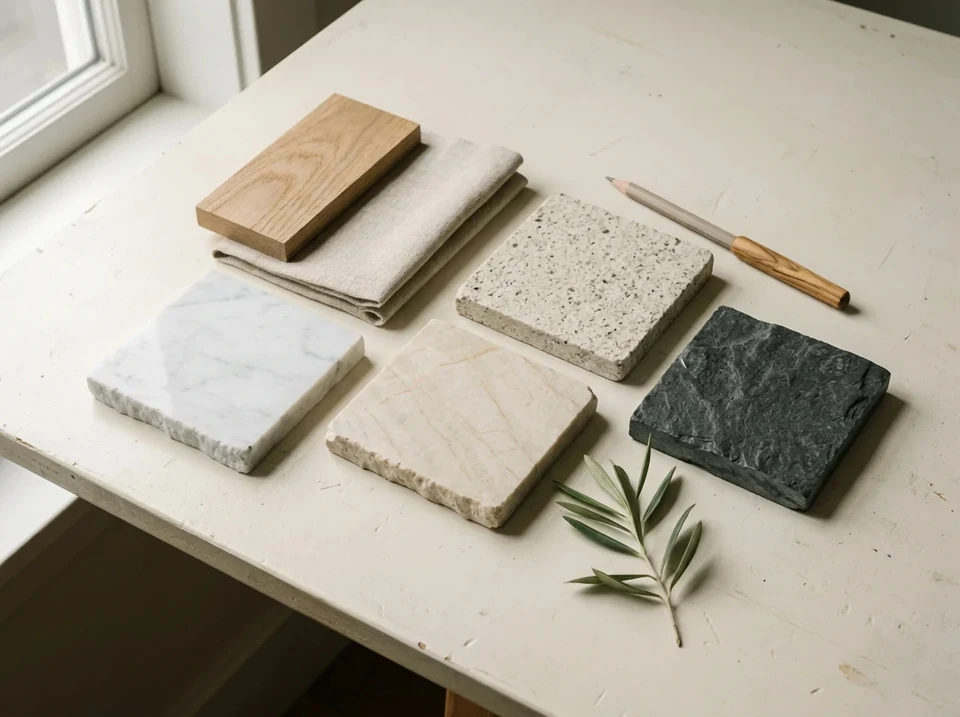
Begin with how you live
The most useful first question is not “Which stone is best?” It is “What happens in this room?” A busy family kitchen, a quiet guest vanity and a place to roll pastry have different demands. Write down your daily rituals, how much maintenance you want to do and the details that matter to you. Those answers give your fabricator a far better starting point than a photograph alone.
Similar names, different origins
Quartz surfaces are engineered with mineral particles and binders. Quartzite is a natural stone with patterns that belong to a particular slab. Granite is another natural stone family, often with visibly granular mineral character. Names in supplier catalogs can be inconsistent, so ask for the actual classification and the specific manufacturer documentation rather than relying on a color name.
Let the whole slab speak
A small sample shows tone and texture, not the whole composition. If movement and veining matter, view the actual slab and discuss where the pattern will fall around the sink, corners and seams. The images in a visualizer are useful for trying a mood, but they are not a substitute for reviewing the piece you intend to use. Natural variation is part of the appeal—and part of the planning.
Ask better questions, choose with confidence
Confirm the finish, thickness, usable dimensions, edge options and care instructions. Use trivets rather than assuming any stone is immune to heat. Ask whether sealing is appropriate for that exact material. Finally, request a quote that separates the material from fabrication and installation. A clear specification makes an inspiring choice a practical one.